← Project LabSaaS Platform
VIBE CRM
CRM infrastructure built for real estate teams that actually close.
A production multi-tenant SaaS CRM with pipeline kanban, automated SMS and email sequences, a CFO-level analytics dashboard, and full team-based permission isolation. Live on Vercel, serving real estate teams today.

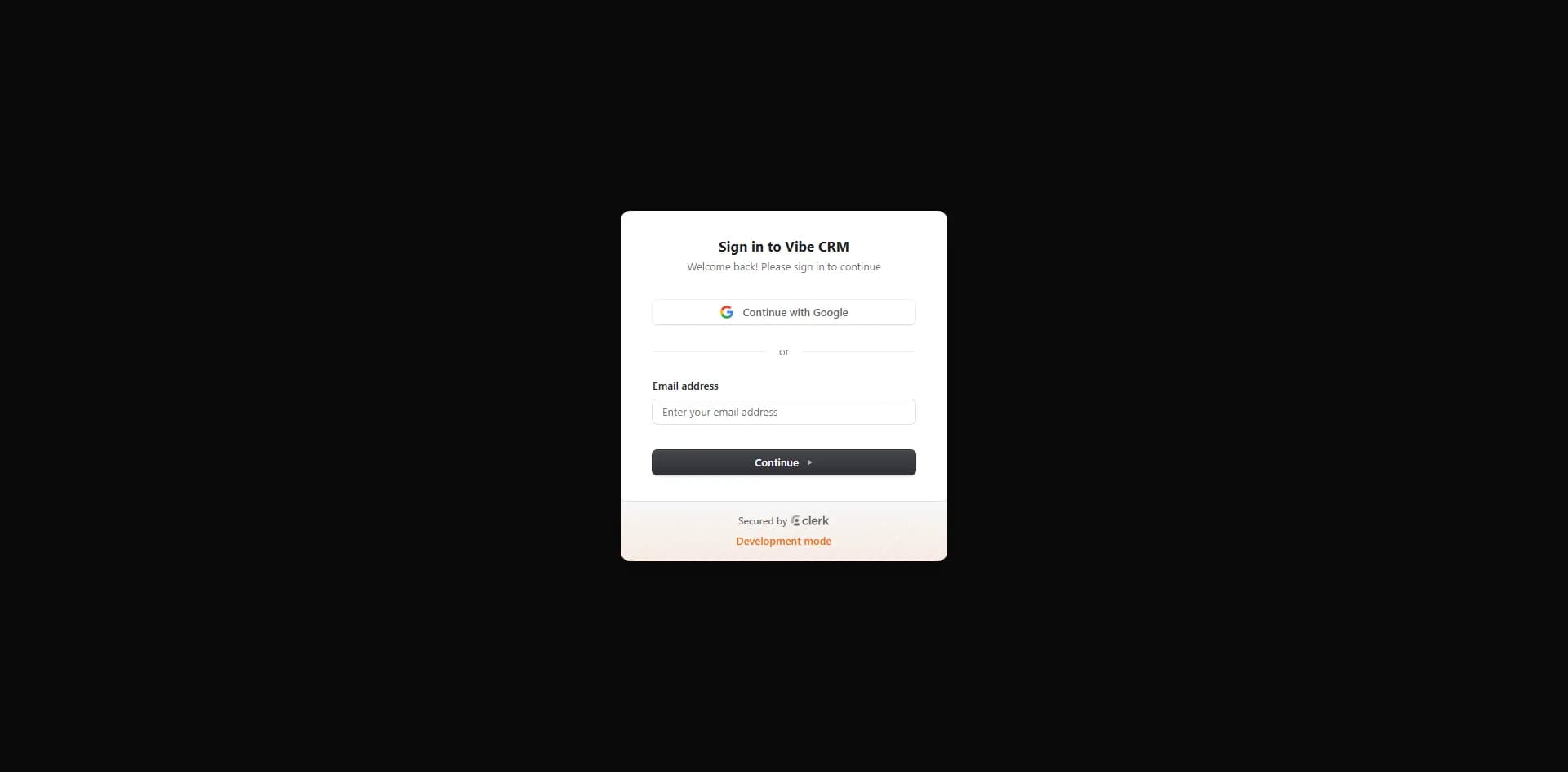
Live authentication screen
Live Screenshots
The platform, in production.
Landing page with CRM feature overview
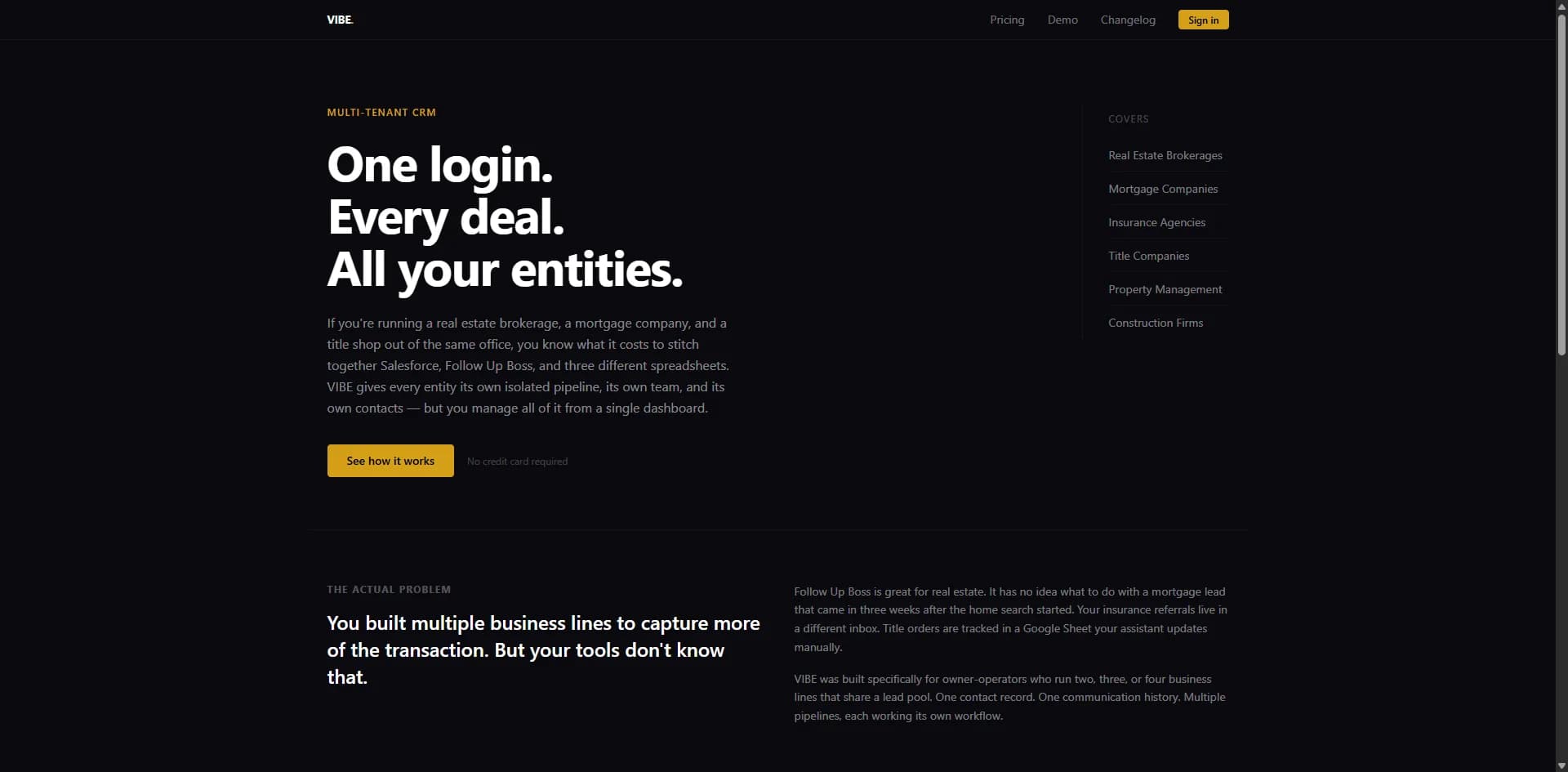
Multi-tenant CRM features and integrations
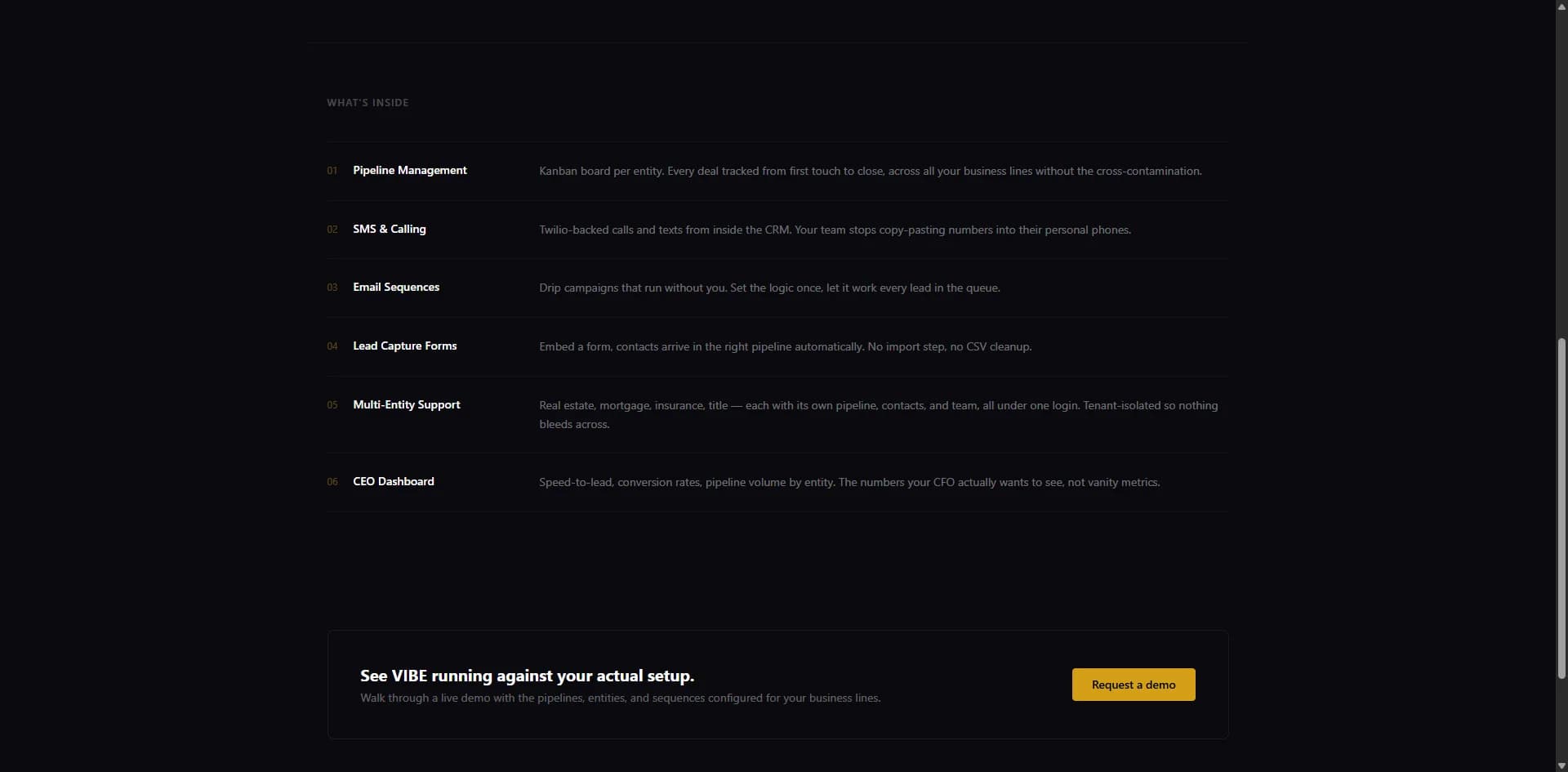
Pricing tiers and plan comparison
The Challenge
Multi-tenant isolation without sacrificing feature depth.
Real estate teams operate differently from traditional sales orgs. They need contact pipelines tied to specific agents, shared inboxes with role-based visibility, automated follow-up sequences that know not to double-send, and financial dashboards that surface the metrics brokers actually track, not generic CRM charts.
The hardest engineering problem was multi-tenant data isolation. With 40+ Prisma models and complex relational queries, every data access pathway had to be tenant-scoped by default, not as an afterthought. A contact owned by Team A cannot surface in Team B's pipeline, even for admin-level users.
Clerk's organization model was the foundation, but the real isolation work happened at the database query layer. Every Prisma query is constructed with an implicit tenant filter, enforced at the service level, not at the UI level.
The Solution
A CRM that does the work, not just stores it.
Pipeline Kanban
Drag-and-drop pipeline stages with custom column definitions per team. Cards carry full contact context: last contact date, assigned agent, active sequences, and next action flags.
SMS + Email Sequences
Automated multi-step sequences via Twilio SMS and email. Sequences are contact-scoped, have configurable delays, skip weekends optionally, and halt automatically on reply so you never blast someone who already responded.
CFO Dashboard
Financial metrics built for brokerage leadership: GCI tracking, agent performance breakdowns, pipeline velocity, and projected close value, all scoped to the team's actual deal data.
Team-Based Permissions
Roles map to Clerk organizations. Admins see everything. Agents see their assigned contacts and pipeline. Brokers see team-wide data with agent attribution. No cross-contamination between tenants.
Stripe Billing
Subscription plans with Stripe Billing. Teams upgrade, downgrade, and cancel through a self-serve portal. Seat count adjustments update permission scopes in real time.
60+ Typed API Routes
Every route is validated with Zod, authenticated via Clerk middleware, and tenant-scoped at the service layer. No unprotected endpoints. The API is the enforcer, not just the messenger.
Platform Architecture
Multi-tenant isolation at every layer.
Multi-Tenant Data Isolation
Every database query is constructed with an implicit tenant filter at the service layer. This is not a UI-level check. The Prisma client never executes a query without a tenant scope, which means cross-tenant data leakage is architecturally impossible, not just unlikely.
Team-Based Permissions
Permissions map to Clerk organizations with three role tiers: Admin, Broker, and Agent. Each role has a defined scope of what data it can read, write, and delete. Permission checks happen at the API route level before any data is touched.
Row-Level Security
Beyond application-level tenant filtering, the database enforces row-level access patterns. Contact records, pipeline stages, and sequence data all carry a tenant ID foreign key. Orphaned records without a valid tenant reference are rejected at the schema level.
Data flow for every request
1Request hits API route→
2Clerk middleware extracts auth + org ID→
3Zod validates input shape→
4Service layer applies tenant filter→
5Prisma executes scoped query→
6Response returns tenant-safe data
System Map
Every service, connected.
Core Features
The systems that run the CRM.
Pipeline Kanban
The pipeline is not a generic kanban board. It is purpose-built for real estate deal flow with stages that match how agents actually track leads from first contact to closing.
Drag-and-drop cards between custom pipeline stages
Each card shows last contact date, assigned agent, and active sequences
Custom column definitions per team, not a one-size template
Next-action flags that surface which deals need attention today
Bulk operations for moving, archiving, or reassigning contacts
Stage-level analytics showing conversion rates between stages
Mobile-responsive layout for agents working in the field
SMS Sequence Builder
Automated multi-step SMS sequences via Twilio that handle the follow-up cadence agents forget to do manually. Sequences are smart enough to stop when they should.
Multi-step sequence creation with configurable delays
Per-contact sequence enrollment with deduplication
Automatic halt on reply so active conversations are not interrupted
Weekend skip option for sequences that should only send on business days
Merge fields for personalized messages (name, property, agent)
Sequence performance tracking with open and reply rates
Two-way messaging view for manual follow-up after sequence ends
CFO Analytics Dashboard
Financial metrics designed for brokerage leadership, not generic CRM charts. Every metric on this dashboard maps to a number that brokers and team leads actually track.
Gross Commission Income (GCI) tracking by agent and time period
Agent performance breakdowns with deal count and volume
Pipeline velocity showing average days per stage
Projected close value based on current pipeline state
Lead source attribution showing which channels produce closings
Monthly and quarterly trend comparisons
Exportable reports for leadership meetings
Scale
What 60+ routes and 40+ models means in practice.
The numbers are not vanity metrics. Every API route serves a specific user action. Every Prisma model represents a real domain object. The codebase is large because the product is large, and every piece was built intentionally.
For context: 40+ Prisma models is comparable in schema complexity to platforms like HubSpot or Pipedrive. The difference is that VIBE CRM is purpose-built for real estate workflows instead of being a generic CRM with plugins.
60+
API Routes
CRUD, search, analytics, billing, auth, SMS, export
40+
Prisma Models
Contacts, deals, sequences, messages, teams, billing, analytics
15+
Dashboard Views
Pipeline, contacts, sequences, analytics, settings, billing
100%
Zod Validated
Every input and output is typed and validated at runtime
3
Role Tiers
Admin, Broker, Agent, each with defined data access scopes
0
Unprotected Endpoints
Every route requires auth and tenant scope verification
Integrations
Clerk, Stripe, and Twilio — each wired to the tenant model.
Clerk Authentication
Organization-level multi-tenancy with role-based access control. Clerk handles sign-up, sign-in, session management, and org switching. The integration goes deeper than login: Clerk org IDs are the tenant keys that scope every database query.
Org-level multi-tenancy
Role-based access (Admin, Broker, Agent)
Session management with JWT verification
Org switching without re-login
Stripe Billing
Full subscription lifecycle management. Teams sign up for a plan, upgrade or downgrade through a self-serve portal, and seat count changes propagate to permission scopes in real time. Webhooks handle payment failures, cancellations, and invoice generation.
Subscription plan tiers
Self-serve upgrade and downgrade
Seat-based pricing with real-time scope updates
Webhook-driven payment event handling
Twilio SMS
Outbound SMS sequences with two-way messaging. Messages are sent via Twilio with delivery status tracking. Inbound replies are captured via webhook and surface in the CRM conversation view so agents can continue the thread manually.
Multi-step automated sequences
Two-way messaging with reply capture
Delivery status tracking per message
Webhook-driven inbound message handling
Tech Stack
Six technologies. Each one earns its place.
Next.js 15App Router, server actions, API routes
Prisma40+ models, multi-tenant row-level isolation
PostgreSQLPrimary database with tenant partitioning
ClerkAuth with org-level multi-tenancy and team roles
StripeSubscription billing, plan tiers, usage metering
TwilioOutbound SMS sequences and two-way messaging
VIBE CRM Build Status
Deployed. Onboarding early teams. Still shipping.
VIBE CRM is deployed on Vercel and onboarding early real estate teams. The platform handles multi-tenant data isolation correctly, billing works end-to-end through Stripe, and SMS sequences run without intervention.
The 40+ Prisma models and 60+ routes aren't impressive because of the count. They're impressive because each one is intentional. There's no model that doesn't serve a real user workflow. No route that isn't tested against the tenant isolation guarantee.
This is what CRM infrastructure should look like when it's built specifically for the people using it, not adapted from a generic template.
Multi-tenant SaaS isn't complicated. It's a solved pattern.
Multi-tenant auth, Stripe subscription billing, role-based permissions — I built all three into one production app. Book the call and tell me what you're shipping.
From the blog
Related articles
Shipping a Full CRM as a Solo Dev
VIBE CRM went from concept to live multi-tenant SaaS in under 60 days. Here's the architecture, the mistakes, and what I'd do differently.
Read articleResurrecting a Dead SaaS: 6 Weeks Down to Fully Live in One Day
My CRM went dark on May 15 when a hosting billing suspension killed the deployment. On July 3 I brought it back in one session: database restored (3 tenants, zero data lost), migrated from Vercel to self-hosted Coolify, Stripe billing live with 3 plans, plus four pre-existing silent failures found and fixed — including a checkout endpoint hiding behind the auth wall that would have bounced every paying visitor.
Read articleAdding a React Native Mobile App to an Existing SaaS
VIBE CRM's web app was deployed but real estate agents live on their phones. Here's how I added a React Native mobile app that shares the same API, auth, and data layer without rewriting anything.
Read article